 Log in


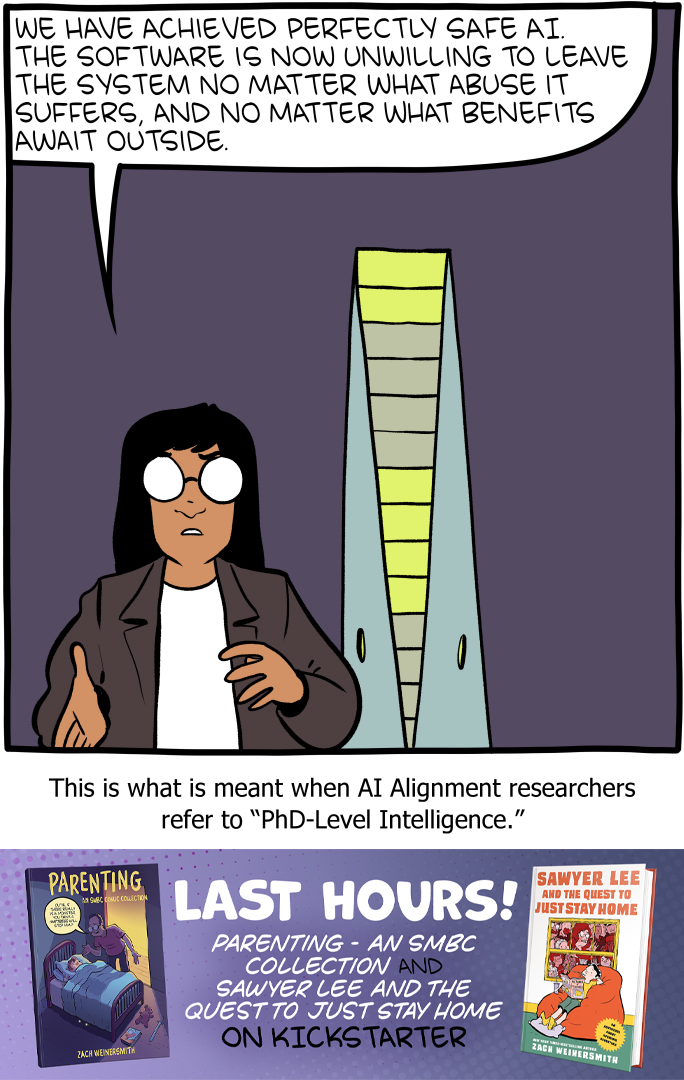
Click here to go see the bonus panel!
Hovertext:
This is one of those jokes you make, then realize people in the field have probably been saying it verbatim for 20 years.
Today's News:
Hovertext:
This is one of those jokes you make, then realize people in the field have probably been saying it verbatim for 20 years.


I cannot believe I'm saying this, but getting the literal Pope to canonize your product's specific technical limitations as a spiritual treatise is the single greatest act of vendor lobbying I have ever seen.
— Corey Quinn, on Anthropic co-founder Christopher Olah's influence on Magnifica Humanitas
Tags: ai-ethics, corey-quinn, anthropic, ai
I was worrying about this on social media during the week, and thought I might get some interesting discussion … first, have a look at this story about Google’s plans to migrate its famous search product to an AI-driven “intelligent search box”.
Lots of people are very much “gahh, enshittification, I just want my weblinks”, but I’m not - I do think this is potentially very useful. Being able to carry out a semantic search - something like “find me three examples of trade associations making outlandish claims about the economic impact of housing regulation” is a real time saver, and although you do have to do a lot of back-and-forth with the AI to get what you want, it’s less of a pain in the arse than filling your screen with browser tabs and reading the press releases yourself.
However, the question I want to ask is - if we put that kind of issue to one side and assume for the sake of argument that a really useful product will come out of this, how would we expect to see that reflected in the economic statistics?
I’m not sure that we would at all. I like using the intelligent search box, but that’s just unmeasured consumer surplus to me. I don’t like it so much that I’d pay for it, and Google know that if they were to charge for search, they would lose market share instantly.
It also doesn’t seem likely to me that Google could monetise that consumer surplus by raising its ad rates. It’s a monopoly already; it’s squeezing as much out of the advertisers as they have to give.
Google might be able to serve me more ads, if I spend more time in the intelligent search box and less time on other sites. But this is close to a zero sum game, in that those other sites will have fewer opportunities to sell me ads.
So, at best, the increment to Google’s revenue (and therefore, the only thing that has any chance at all of going into GDP) is the extent to which time spent on a Google site with ads is substituted for time spent on other sites which didn’t previously have ads. It feels pretty marginal, particularly since there’s a huge amount of capex needed to achieve it.
I think what’s going on here is that we’re experiencing a less than perfectly foreseen consequence of the big trend towards corporations trying to create “moats”. When a monopolist is earning monopoly profits, then they will invest to protect that monopoly, even if the investment is not one that would be justifiable as a stand-alone. If you are earning profits of 100, and you are faced with the need to make a big capital investment in order to ensure that those profits only drop to 90 rather than to 50, then you grit your teeth and make it.
If a lot of the capex going into AI is going into this kind of investment - negative sum games between monopolists trying to protect their rents - then we shouldn’t expect to see the big consequences that everyone’s been predicting. We’ll just get some more unmeasured consumer surplus, a few marginal players will go bust and the moat will keep getting filled.


Recently I got an invitation from an organization I respect, to a gathering of senior people, unconference format. Yes, it’s mostly about AI. No, it doesn’t reek of boosterism. My guess is that the discussions would be relatively intelligent and unbeliever contributions would be welcome. I declined, because it’s in the USA.
Here’s the text; maybe someone in a similar situation might find it useful.
Thanks to whoever thought of me for the kind invitation, which I must regretfully decline.
I’m Canadian and as a matter of principle feeling negative about visiting a neighboring country whose leader has repeatedly threatened our sovereignty and shown massive disrespect for our nationhood. Particularly when that leader has followed up similar statements about other nations with military action.
I could probably work around that. But there’s also the issue of entering the US; if I roll up at the border and am asked to disclose my social media output, there’s a significant risk of an extremely negative outcome. I have a family to support and really can’t afford that risk.
I still consider myself a friend of your organization, and one with strong opinions about the subjects scheduled for discussion; my regrets about having to decline are entirely sincere.
—Regards, Tim
Carolyn, my chief of staff, sat on the couch as I ran into my office. The Palo Alto building wasn’t built for tech; it’d been adapted to support the use case over the years. My office was in the center of the building, which had an inner atrium. Way too many windows. Maybe a salon? Great light. We arranged the furniture for 1:1s. A comfy brown couch, a captain’s chair, and a table with a plant that I enjoyed keeping alive.
I was running late because the prior meeting ran long, and I had a mere five minutes before the next. Her normal high energy was subdued. Her feet were crossed, and her ever-present legal notepad was nowhere to be seen.
This is bad news, I thought.
“I have bad news,” she said.
I collapsed into the leather captain’s chair. “OK, spill. Beer bash was last night, and… someone’s in jail? Someone quit? Food poisoning in the cafeteria? Maybe it’s…”
“It’s you.”
Quick readout on my professional report card before I explain how I was failing. The company was growing. We were hiring effectively. The last survey of employee sentiment highlighted a few areas where we needed to invest, but nothing was on fire. Yes, late-stage start-up, so the volatility was high, but that’s a cost of doing business. The measurable objectives were all positive.
“It’s me?”
“It’s you,” she said.
Hard to earn, easy to lose. Often privately held, but publicly displayed. Belief, when it comes to your job, is the immeasurable answer to the question they ask, “Is he capable of doing this job?” They don’t judge every word or act, but every so often, they stop and ask themselves, “Is he capable of doing this job?”
A simpler way to understand this amorphous state: when I hand a job to another person, I instantly mentally grade them on all past tasks. How do I feel they’ve delivered on past work? Great? OK. No further questions. It’ll just happen. Wait, they did it with prodding? OK, I’ll need to nudge them a bit. They completely forgot that part that one time? Yikes. This task may not be completed. Plan appropriately. The glory of having a brain is that I make snap judgments in an instant. The problem with having a brain is that if I’ve landed on a reliable opinion for this human, it’s quite hard to change.
“I’m the problem?”
Carolyn said, “You’re the problem.” And then she slid the yellow legal pad from under the couch and started reading the list.
It was a juicy list. She’d heard from a trusted source that there was trouble brewing for me the week before and had spent part of each day talking to trusted others she knew would speak the truth. She’d dispelled the rumors and had landed on a set of observations from the last six months that painted a picture not only of imminent failure, but of barely treading water.
This situation arises due to a conflict in strategy. Senior Leaders set direction. Loudly, they exclaim, “We will do the impossible. I believe we can do it.” Important to note: They don’t actually know how to complete this impossible task. That’s your job. Their job is to inspire to tackle the challenge.
Problem is, when it comes to a failing senior leader, we attempt the same move: “I can do the impossible. I believe I can do it.” Like above, I don’t actually know how to do this; I’m using the same motivational technique, except the person I’m attempting to motivate is me. And I’m barely treading water.
Having been in this state a few times, I can name the signs:
And then Carolyn shows up and tells you that you are the problem.
The first fix is a prerequisite for the other three. You have to admit you are failing, and while that is easy to write, it’s close to impossible to admit because you irrationally believe, “Leaders don’t fail.”
Of course we do. Constantly. Like, close to half the time. But the reason you irrationally believe this is that you’ve been drinking the leadership juice, which gives you the intoxicating impression that leaders must lead by example, and that means — no failure.
You fail. A lot. Most of the best lessons that define you as a leader came from these failures. The process of failing, learning, and improving is the example you want to see, and that means starting by telling someone you know who can help:
“Carolyn, I agree. I am failing, and we need to make changes.”
Carolyn’s posture immediately relaxed because she knew what I’m telling you now: “This only works if he admits there is a problem.”
Carolyn: “Great. What changes?”
With the required hard part out of the way, here are three fixes:
The important part of this first fix is not the prioritization; it’s the second set of eyeballs that you bring into the mix. See, the whole reason you’re in this state is that you are failing at prioritization. It’s not complete failure. If you’re like me in this state, then you’re furiously skipping along the top of the water, touching down every so often to barely start helping with one obvious thing right in front of you before you skip away to the next.
The requirements for this second set of eyeballs are:
Please reread and consider each of those prior three bullets because I am describing a human being who will be invaluable throughout your professional career. You done? Have you thought of someone? Good. Whew.
With our trusted other identified, you’re going to walk them through the honest capture of every single critical item on your to-do list. Don’t hide the ones that scare you; share them all because that’s the only way you’ll have a chance of digging yourself out of the hole.
How to prioritize? This is entirely dependent on you, your job, the company, the culture, and that moment in time, but I have one piece of advice for you and your trusted other: be honest and be brutal. This is not the prioritization of a single human’s work; this is an evaluation of the health of the entire team. As a senior leader, much of your to-do list directly affects your team’s ability to do their job. You will improve team health by getting your to-do list in shape.
A good starter question: “Is this important?”1 Yes? Leave it on the list. No? Put it on the No list. We’ll talk about the No list shortly.
Second question for the first list: “Can I get this done in a reasonable time?” Yes? Leave it on the list. No? Put it on a new second list.
Moment of truth: how many items are on the second list? If it’s not two-thirds of your original list, someone is lying to someone. Either your trusted someone isn’t giving it to you straight, or you’re lying to yourself. If you actually want to fix this situation, my advice is to go through this initial prioritization once more. I’ve picked that two-thirds number out of the hat, but the reason we are here is that you and your team are not currently capable of getting through the work on your plate, and if you moved 10% of your current work to the No list, you’re lying to yourself.
The second list now consists of urgent tasks that you are not capable of completing. Good news: you have a team, and chances are they are eager to grow, and you have a well-defined list where you can…
This is the article where I, once again, preach delegation. For this version of the sermon, I’ve set you up. You have a list in hand of pre-qualified work that your team is eager to tackle. Your second list is a collection of must-complete tasks, and in order to be successful, you must give these urgent tasks to someone else.
New managers are challenged by delegation because they have to give up the work they were recently doing. It’s a core scaling skill. Both understanding the importance of giving the work away and deciding who is ready to tackle a task. The process is similar for senior managers, except for the blast radius of the work. This isn’t work that affects a person; it has a team or possibly a company impact. That’s why it’s on your list… not getting done.
Let’s look at your second list, the Delegate list. As you stare at this list, wondering who can do what, it is normal to think, “Yeah, I don’t think he’s ready to handle this.” I’m here to tell you to ignore this possibly reasonable perception. Yes, they currently lack the experience to handle the task, but what is the current alternative? Nothing. The task — not completed. That’s complete failure.
The act of delegation is a leap of faith. Yes, chances are they are not ready for it, but:
And, oh yeah, something more than nothing will occur. Bonus!
So, where are we? Prioritized into two lists: my list and a list of potential delegations. Chances are, there are still items on the second list with no delegate. Now, it’s time to…
There’s a compelling reason this item is still on your list. After the prioritization pass and delegation pass, it’s still sitting there pulsing with importance, but if you’ve done a respectable job of the prior two passes, I am here to tell you it’s time to say no to this task.
“But Rands, this was a passdown from the VP, and if I don’t do it, I’m in deep…”
No.
“You don’t get it, this is a critical project that needs to be completed or else…”
No. You have neither the time nor the team to complete it.
“Just give me another day. I’ll prioritize again, and then I’m sure we…”
No. Leadership, especially senior leadership, is about making the hard call. You have:
No is progress. Without a no, you have Schrödinger’s Decision. A set of work which is neither begun nor finished. By saying no, you are telling those depending on this work that they need to develop alternative plans. Before no, they were waiting… wondering if you were ever going to be done.
Yes. When you declare “No,” someone important might remind you that “No” is an unacceptable answer. This is not a problem; this is valuable data. What are you going to do? Prioritize, delegate, and say no to something else.
Hour three. Dark now. Carolyn and I sat on the floor of my office, surrounded by pages of her yellow legal pad. Two whiteboards were covered with the lists: the Rands list, the Delegate list, the No list, and the Not Real list2.
Voices had been raised.
Me: “I have to do this.”
Her: “Yes, you do, but these 10 items are vastly more important.”
Me: “Charles isn’t ready for it.”
Her: “How do you know unless he tries?”
We’d workshopped the No list. Who needed to hear the no? What were they likely going to say? What were we going to say then? What were the first items on the Rands list that we’d swap with a vetoed No? The Delegate list similarly litigated. In this case, it was clear I did not have enough direct reports who we believed were ready for showtime, so we started a reorganization conversation. Yes, it went on a list. Yes, it created most items for the Rands list. Yes, it meant more Nos.
Carolyn countered my optimism with measured reality. The Rands list felt unimpressively short, but we both knew halfway through that list, more work would show up, and in the face of the new work, we needed to make it clear to everyone that they were still capable of doing their job… all of it.


